







PoC vs. Prototype vs. MVP: How to Turn an Idea into a Working Product
The idea is the beginning of every great product. However, it is not about simply leaping straight into the development when it comes to taking that idea and transforming it into something people actually use and pay money to use. It consists of a process that typically takes three major steps: Proof of Concept (PoC), Prototype, and Minimum Viable Product (MVP).
Although it may seem alike, each of them contributes to the validity and formulation of your product vision in a distinct way. The difference can save you time, money as well as a lot of frustration in the future.
Unpacking what each one of these entails and when to apply them.
Proof of Concept (PoC): Testing the Feasibility
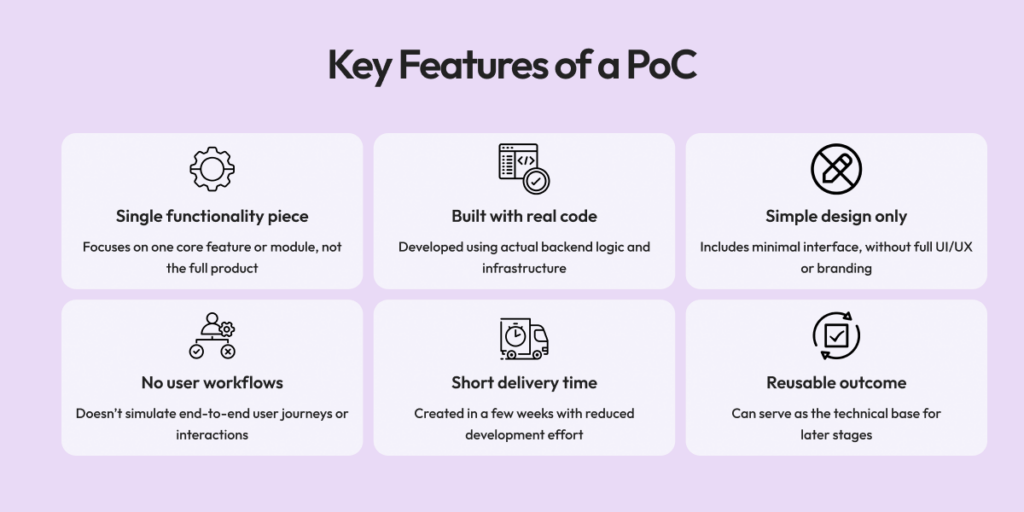
The Proof of Concept is simply a question of one thing: Can this idea work?
This is the product’s test phase. You are not attempting to create something that can be played with by the users but to show that your idea is technically feasible or that your path of action is reasonable.
Suppose a startup wants to develop a wearable that measures hydration levels through the skin. The team must ensure that hydration can be detected properly by the sensor technology before they come up with smooth wristbands or fancy applications. That’s the PoC.
At this point, the product may be in a form. It may be a small test in a laboratory, a spreadsheet with the accuracy of an algorithm or even a hand-simulated digital process. It is not intended to impress the customers, but persuade oneself (and possibly the investors) that the idea is underlying
PoCs help companies to minimize technical or business risks. Should the idea go bad at this stage, it is much better to determine early enough before a single cent and time is spent in developing the actual product.
An example of a PoC in software creation may be a rudimentary implementation of a feature, such as the speed at which an AI model can identify objects in an image to use in real-time. When it succeeds, then you go ahead with confidence. If not, you pivot or refine.
Read: Performance Testing vs. Load Testing: Understanding the Key Differences
Prototype: Bringing the Idea to Life
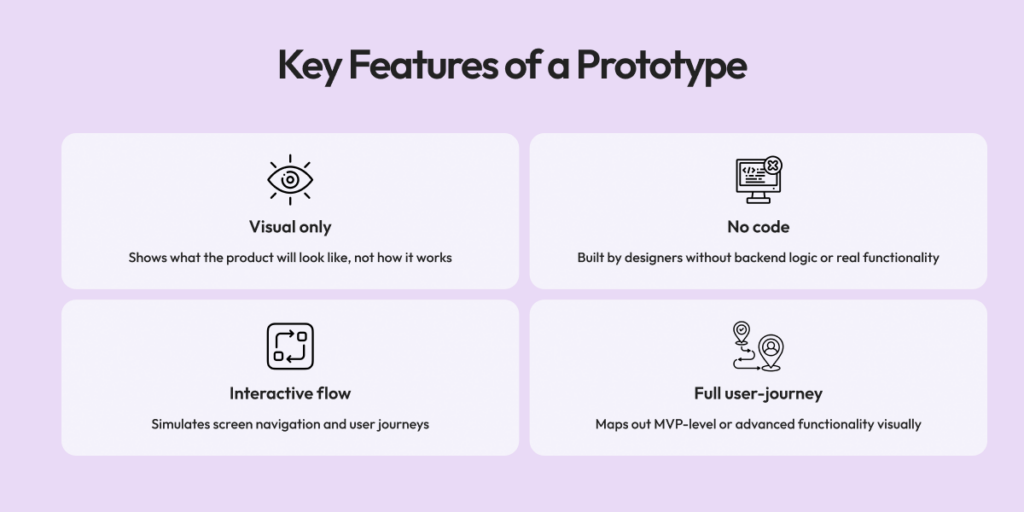
After the idea has been made viable, the second task is to make it a reality based on its visual and functional representation. That is where a Prototype comes in.
A prototype is an initial model of your product – a model that is a physical representation of how your product would appear, feel, and act. It is not intended to be used by real users but is useful in discussions between internal users, stakeholder presentations or early usability testing.
Imagine a designer sketching in Figma or building a click-through model that feels a navigation. You are able to tap buttons, swipe between screens and have a feel of the user flow, even without the backend being available.
In hardware, a prototype might be a 3D-printed model of a proposed product or a prototype made from existing parts.
The objective of this is to answer the questions that will be of the type: How?
- What is the interaction between the product and the users?
- How should it look and behave?
- What can we to improve the design or experience before the development stage?
Prototypes are extremely helpful since they can result in fast feedback. You will be able to present it to your team, investors or even some potential users, and revise it according to the responses of those. Moving a button in a design file is significantly less expensive than writing a second time.
Several prototypes are often run through the teams to start with low-fidelity wireframes, followed by higher-fidelity mockups, and then perhaps an interactive prototype simulating actual workflows. At the end, all have a clear picture of what is being constructed.
Minimum Viable Product (MVP): Testing in the Real World
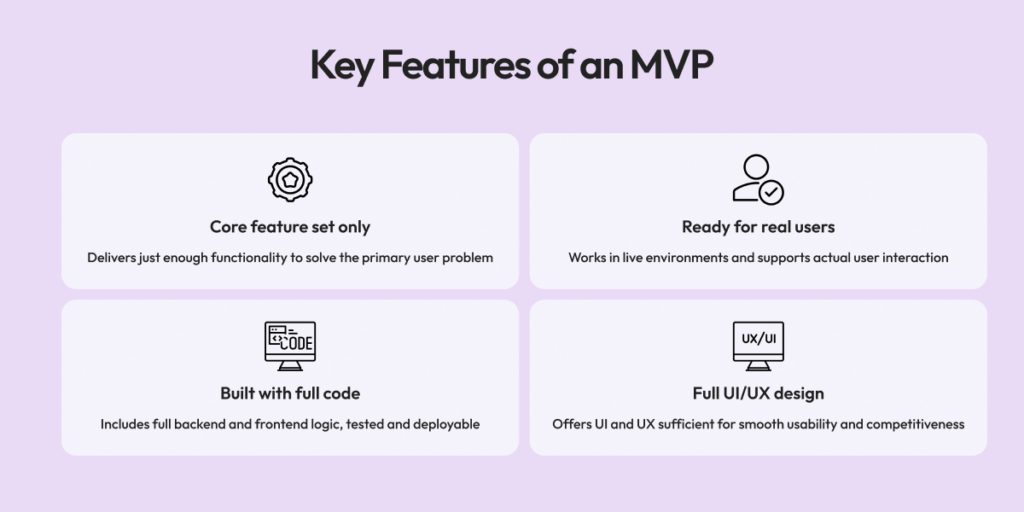
When a prototype is useful in visualizing the product, the MVP is useful in testing it in the real world.
Minimal viable product simply refers to a basic version of your product that has some features that can be used by early adopters to address at least one core problem. It is not smooth, it is not that good, however, it functions.
The primary aim of MVP is to get acquainted with real users. You are trying the assumptions about your market, not only your technology.
Take Airbnb’s early days. The founders did not create a full-fledged international booking platform immediately. They designed a minimal site to rent air mattresses to conference visitors in their apartment. This was sufficient to demonstrate that the individuals were ready to pay to remain in the house of another person. That’s an MVP in action.
Or look at Dropbox. They created an abbreviated video of what their product of file-synching would accomplish before they wrote a single line of code. Thousands of individuals subscribing to test it – confirmed that the idea was not unrequested. Such a premature validation enabled them to have the confidence (and capital) to develop the actual product.
An MVP allows gathering useful data: Are people really interested? What are the characteristics that they are most concerned about? What can you make simple or do away with?
Start simple, quantify behavior, learn in the short-term, and repeat. When you know that your product is solving a genuine problem and people are ready to pay or get involved, you can begin scaling without apprehension where you’re building a minimal viable product, PoC or a prototype.