









Content Marketing vs SEO: What Most Marketers Get Wrong
Have you ever poured your heart into writing a great blog post, just to see that no one visits it? It’s frustrating. Although the content is valuable, it does not reach your intended audience. It might be that you have filled your article with popular keywords in order to rank higher but find that readers come and go without reading what’s on your page.
That’s an interesting aspect of content marketing and SEO. While both want to help people, these techniques are usually managed individually. Content marketing is based on telling stories and building trust. On the other hand, SEO commonly focuses on the technical aspects of getting noticed. Because they seem so different, they’re often kept apart.
But here’s a twist. Even with strong efforts, if your content and SEO are not aligned, your results will fall flat. If you don’t optimize, great content gets buried. Clicks win with SEO, but that’s all without substance, no connection. When you mix content for people with smart SEO, that’s when the real impact happens.
And what’s surprising is how many businesses miss this. According to a HubSpot report, 75 percent of marketers think that AI-powered search will increase blog traffic. 68% expect more visitors on their sites. But of those B2B marketers, only 40 percent have a documented content strategy. And that’s a big gap between intention and action. When content is driven solely by keywords, it will spike in traffic for a while. But without value, engagement falls off and search rankings tank. Google notices. Audiences move on. This leads to a damaged brand reputation and wasted effort.
What if we changed the way we looked at it? What if content and SEO were not separate choices but parts of the same strategy? In this blog, we’re going to take a look at the common myths that marketers often believe, what modern SEO actually looks like and how to create content that works in search and actually engages the reader.
1. SEO Is Just About Keywords
Now that we’ve seen how content and SEO are better together than apart, let’s dig a little deeper into one of the biggest misunderstandings in the industry. Many people still think that SEO is all about keywords. All you have to do is sprinkle in the right phrases and your content will start rising to the top of Google. While this idea seems easy but as we’ve begun to discover, SEO today is not easy at all.
Remember when you wrote a valuable blog post that didn’t do so well? If SEO were just about keywords, stuffing a few into your article should have worked. It didn’t, though. That’s because search engines are becoming smarter. They don’t look for specific words. They’re trying to figure out what a page is about and if it’s really fulfilling the reader’s intent. Today’s SEO is more of a conversation between your content and the person searching. It’s about knowing what someone is actually after and providing a meaningful answer. BERT and the Helpful Content Update are designed to do exactly that. They are constructed to detect relevance, depth and clarity. They reward content that delivers what it promises and they do it honestly.
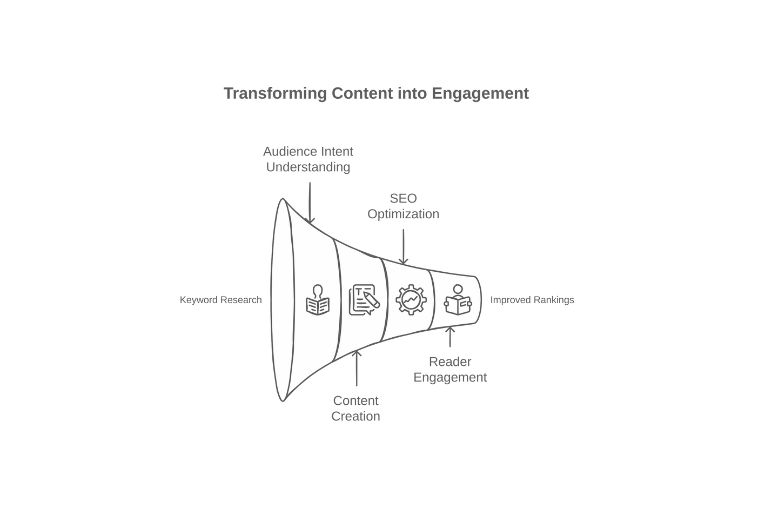
This is how content marketing and SEO overlap in really exciting ways. When you write a blog post with the intent of the audience in mind, to keep them engaged, and with the support of thorough keyword research, your blog post is more than just another search result. It becomes something useful and something that people remember. Keyword-first strategies usually fail because they forget the reader. You can’t just optimize for ranking terms without the page behind them serving a purpose. People will bounce. It will be noticed by Google. And the rankings will fall. However, when keywords are used to help drive content, not force it, that’s where you begin to see real growth.
For example, look at AwardWallet. They didn’t chase rankings blindly, instead they focused on creating a content experience that matched searcher intent, provided real value and was supported by smart SEO decisions. The result? 46 percent increase in traffic and 3 million Google clicks. That’s not magic. That’s strategy. It does prove the point we started with. Keywords are not all about SEO. It’s the whole journey that your content takes a person on. The clearer your journey, the better your results.
Read: Best Dental Implants: Recovery and Aftercare Guidelines
2. Content Marketing Doesn’t Need SEO
Well, if great content is necessary for SEO to thrive, can great content still thrive without SEO? After all, if something is really helpful or beautifully written, won’t people just discover it? It’s a nice thought, but the internet doesn’t work that way. In fact, this very idea is one of the biggest traps marketers fall into. We spend time and creativity on content that educates, entertains or motivates. However, without SEO to bring people to this content, even the best pieces can easily get lost in the vast expanse of the internet.
Recall what we went through earlier. People want the exact thing they’re looking for and Google is trying to give it to them. So how can it do that if it doesn’t even know that your content exists? This is why SEO is important. It acts like a bridge that lets search engines know your content exists and what it’s worth . That’s why site speed, mobile optimization and metadata are not just technical details. They are a part of how content gets seen. Search engines will probably rank your page lower if your page loads slowly or is difficult to read on a phone. If it doesn’t show up near the top, most people won’t even click through to read it.
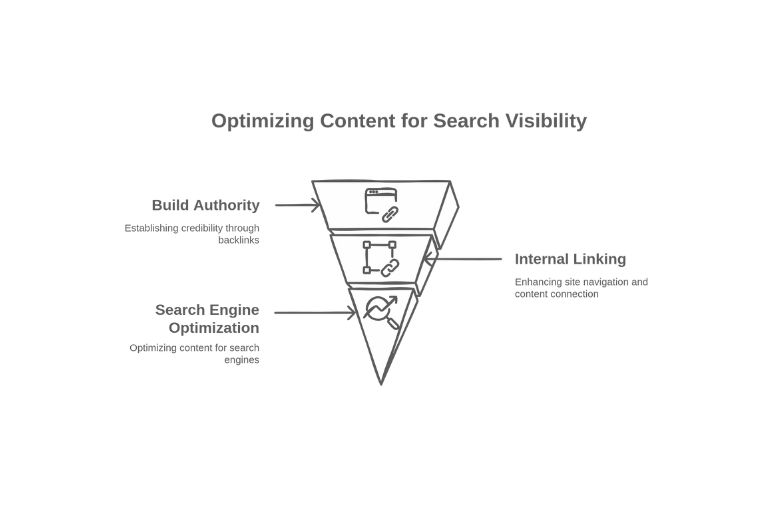
Also, there’s the matter of authority. Just as people trust recommendations from friends, search engines also look for signals of trust. Reputable sites linking back to you and smart internal linking tell Google your content is reputable and well-connected. Without these signals, your most thoughtful blog post can stay invisible. The numbers back this up too. Organic search is responsible for more than half of all website traffic. People are constantly turning to search engines to find answers and ideas, so that means. You’re missing out on a huge audience that’s already looking for what you offer if your content isn’t optimized to show up in those results.
One of the strategies that has worked wonderfully for numerous businesses is building content hubs. These are groups of related pages that go into a lot more detail on a given topic and are linked to each other with internal links. In addition to helping readers discover and stay on your site, they inform search engines that you are an expert source. This usually results in a surge of both visibility and traffic.
As important as writing strong, compelling content is good marketing, it’s only half the equation. Without SEO, that content may never be found by the people who need it the most.
3. The Winning Strategy: How to Align Content Marketing & SEO
Now it’s obvious that without SEO, great content isn’t found and without great content, SEO doesn’t connect with people. The real question, therefore, is how to bring the two together in a way that actually works.
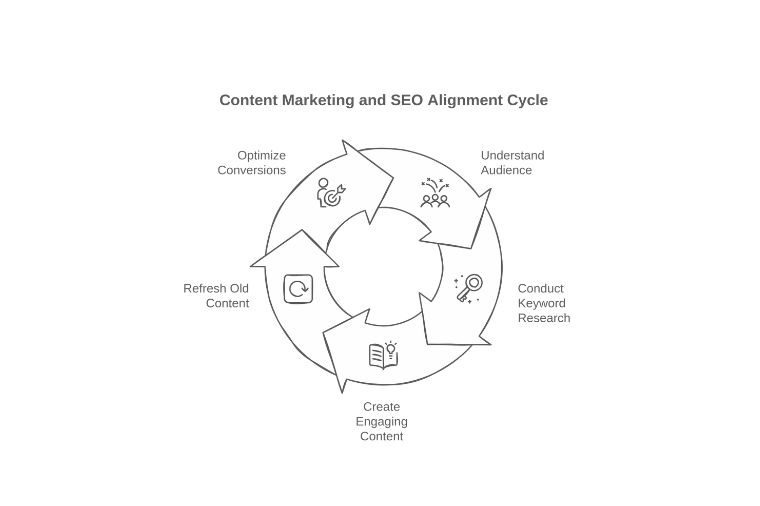
It begins with understanding who your audience is — not just who they are, but what they’re looking for. Search intent helps uncover this through SEO, telling you what kind of content you should create – to inform or to encourage action.
Keyword research becomes a guide. It reveals questions people are asking and where content gaps are. Insight like that gives your content purpose and focus. Having purpose, though, is not enough. Content needs to be interesting. Is it clear, easy to follow? Does it answer the question well? Search engines see how people interact with a page and reward content that actually helps.
In some cases, the best thing to do is not to create new content, but refresh the old ones. Lots of marketers have found that updating old blog posts with new data, better structure and more relevance yields better results. This is a smart and efficient way to increase performance. A great example of this is HubSpot’s blog. They deliver useful, practical content that does well in search and demonstrate what happens when strategy and storytelling combine. The effect is clear when content marketing and SEO work together. More visibility, more trust and content that actually reaches and resonates.
Conversion rate optimization tools(CRO) add an extra advantage to make this partnership even more effective. These tools make sure that once somebody gets to your content they’re nudged in the right direction to sign up, explore further or make a decision. They demonstrate how people interact with your site, where they pause and what gets ignored. With those insights you can tweak your content and layout to make sure that SEO traffic is the right traffic and your content subtly leads people in the right direction. When used thoughtfully, these tools ensure that your efforts are not just traffic, but actual results.
4. Common Pitfalls & How to Avoid Them
To build on how content marketing and SEO work together to create a strong foundation, it’s important to avoid common mistakes that can hurt your results.
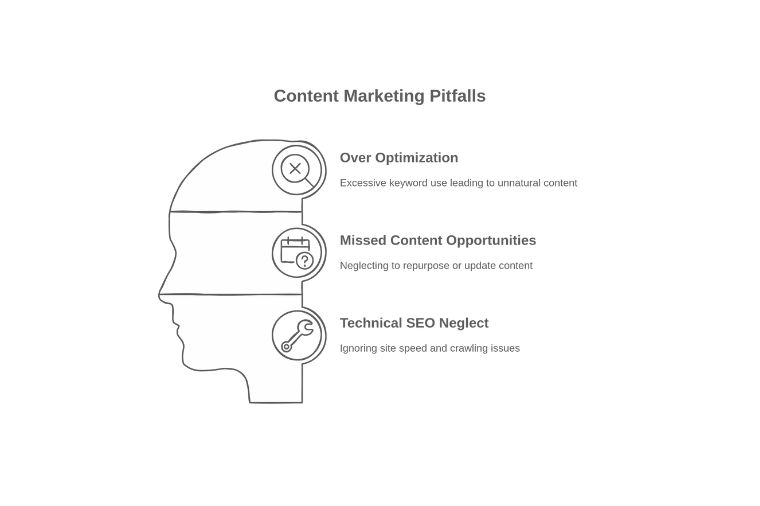
One of the biggest mistakes is over-optimization for keywords. While packing content with keywords may lead to a quick rank, it usually makes it feel unnatural and can deflect readers. Now search engines pay more attention to helpful and straight content, not just keywords. Updating and repurposing content opportunities are other things that are often missed. Turning existing content into a video or social posts and refilling it with new information will help to extend reach and make your efforts worthwhile.
Technical SEO should not be neglected either. Issues like crawling errors or slow site speeds can mess with your rankings and annoy visitors. According to studies, pages that load in one second have conversion rates that are five times higher than pages that take ten seconds. Keeping visitors engaged while providing fast, smooth experiences signals quality to search engines.
A great example of a successful service that has avoided those mistakes is HelloSign. In just seventeen months, their content-led SEO approach saw their organic traffic grow by a whopping over thirteen hundred percent, proving in itself the power of creating quality content and ensuring technical health.
Conclusion
Brands need to understand what their audience is searching for, create high-quality content and get technical SEO sorted out, if they wish to succeed. Publishing content isn’t the end of the work. The key to staying ahead is continuous optimization, updating old posts and tracking how content performs. With artificial intelligence continuing to transform digital as we speak it’s now more important than ever to have a cohesive, documented plan that bridges the gap between content and SEO, so take a closer look at your content, find any SEO gaps and make a plan to connect these two powerful strategies in order to grow your business.
Author’s Bio:
Vidhatanand is the Founder and CEO of Fragmatic, a web personalization platform for B2B businesses. He specializes in advancing AI-driven personalization and is passionate about creating technologies that help businesses deliver meaningful digital experiences.